
%20Registeredv2.png)
INTRODUCTION
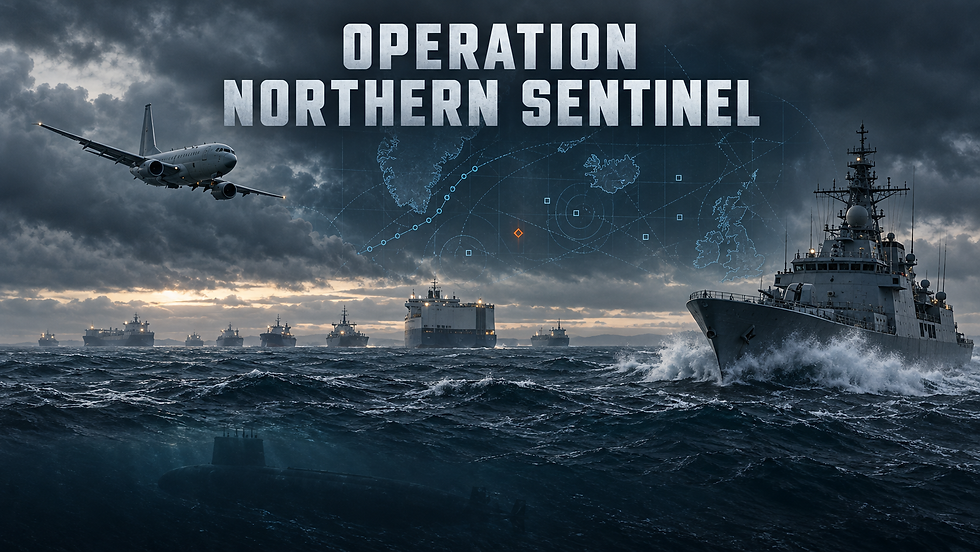
OPERATION NORTHERN SENTINEL is a distributed analytical wargame hosted by Fight Club International for defence professionals, analysts and students of strategy. It follows Iron Umbrella and Gulf Shield, and it moves the problem from air defence to the North Atlantic. You won't be controlling units in real time. You will be planning: reading an incomplete picture, committing scarce forces and stating which risks you accept.
The game can be played individually or as a group sharing one account. Time commitment is approximately 2 hours across two turns.
THE SCENARIO
Context: North Atlantic | Greenland–Iceland–UK Gap | Maritime surveillance and sea control
Task: Get a NATO reinforcement convoy across the GIUK Gap inside a 24-hour window
Threat: Surface warships, long-range aviation and a quiet cruise-missile submarine that intelligence cannot locate
NATO is reinforcing Europe across the Atlantic. Opfor naval and air forces have left their northern bases under the cover of an announced exercise and have not stated their intent. You are the NATO Maritime Component Commander.Your force is small: five P-8A maritime patrol aircraft, a Surface Action Group, a few submarines, limited air cover and intermittent surveillance. It cannot cover three sub-gaps and the convoy at the same time. Neutral shipping uses the same routes. Engaging a contact before it has been properly identified counts as mission failure, whatever the tactical result.


THE FORMAT: OPERATIONAL DECISION GAME (ODG)
Participants do not engage in real-time unit control. You act as the Task Force Commander during the planning phase.
Turn 1 is your Standing Plan. You build it across six planning tabs:
-
Estimate & Intent: main effort, accepted risk, detection priorities
-
Barrier: undersea sensors, submarines and P-8A basing
-
Surface & Convoy: Surface Action Group position and convoy routing
-
Air Defence: cover against long-range aviation
-
ROE & Escalation: identification standards and engagement authority
-
Reserve & Decision Points: what you hold back, and when you commit it
Turn 2 is your Response to Friction. The white cell returns the problems your plan has run into. You respond to them and commit to a forecast of Opfor's next move.
OUTPUT
The game ends with a scored After Action Review. It measures your decisions against what Opfor actually did, under three headings:
-
Barrier, not coverage: did you concentrate where Opfor had to cross?
-
Classification and escalation discipline: did you identify before you acted?
-
Economy of force: did a reserve survive the 24-hour window?
A note on timelines: Each submission is adjudicated and reviewed individually. Expect results in days, not hours.
A note on method: Adjudication combines a white-cell matrix with AI-assisted drafting of friction and AAR content. Every product is reviewed by the white cell before release. This is part of our ongoing research into where AI adds real value to wargaming and where it doesn't.
A note on timelines: Adjudication is not automated — each submission is processed and reviewed individually. Expect the AAR to take days, not hours. This is deliberate: we prioritize analytical depth over speed.
A note on method: We are actively exploring the use of Large Language Models and AI-assisted tools in the adjudication and AAR generation process. This is experimental. Part of what we're learning with this exercise is where AI adds genuine analytical value to wargaming and where it doesn't. Your participation feeds directly into that research.
PARTICIPATE
This exercise is open to registered Fight Club International members. If you're already a member, access the exercise [here]. If you're not a member yet, registration takes two minutes