%20Registeredv2.png)
Gaming Incentives
- edwardfarren
- Mar 15
- 2 min read

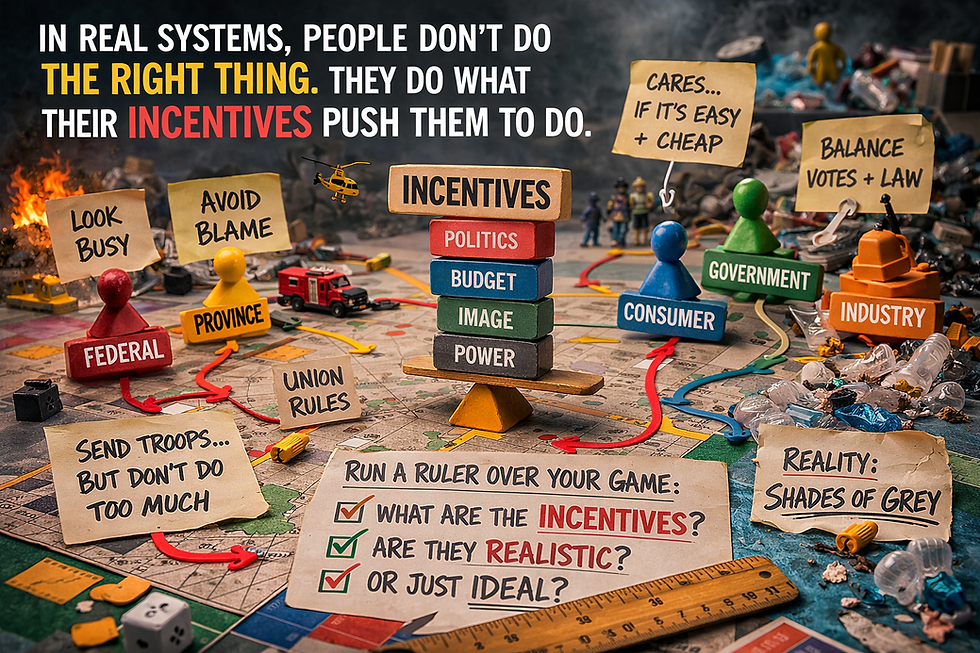
Many serious games model capabilities and processes well, but ignore incentives (also called politics). That creates a quiet failure mode in design. The game assumes every actor shares the same objective, so the system behaves like a perfectly coordinated team solving a problem as efficiently as possible. Real systems rarely work that way. Actors operate under competing pressures, and those pressures often shape outcomes more than the formal capabilities on the table. When incentives are absent, the game drifts toward an idealised world where everyone simply does the right thing. Take a wildfire response game. At the system level, the objective looks obvious: put the fires out quickly and minimise damage. But the real actors do not all want the same thing in the same way. A provincial premier may want to shift blame and responsibility upward to the federal government. The federal government may want to be seen to be acting fast, even if that means deploying troops for political visibility rather than operational effect. Provincial firefighters may resist military substitution if they think it threatens roles, budgets, or union interests. A game that ignores those incentives becomes a coordination puzzle, not a model of a political system under stress. The same problem appears elsewhere. In a plastic pollution game, it is easy to incentivise every actor to reduce plastic use. But that is not how the real system works. Consumers balance environmental concern against cost and convenience. Governments balance regulation against electoral backlash and economic pressure. Industry may want to look green while still prioritising profit. If every player is cast as a white knight, the game produces tidy answers for a world that does not exist. A simple diagnostic helps. Run a ruler over your design and ask what incentives the game creates for each actor. What do they gain by acting in certain ways? What trade offs or pressures shape their decisions? If those incentives do not resemble the real system you are exploring, the model will likely produce elegant answers that rarely survive contact with policy reality. Fortunately, modelling incentives does not require a full political simulation. A few simple mechanics can introduce much of the necessary tension. Give each player multiple objectives rather than a single shared goal. Keep some objectives hidden or only partially visible. Introduce negotiation so players can bargain, trade resources, or exchange favours. Give them something of value to trade, whether money, influence, reputation, or game points. The aim is not complexity for its own sake. It is to make players face competing motivations rather than simply optimise a shared system outcome. Capabilities matter. But incentives usually determine how those capabilities are actually used.